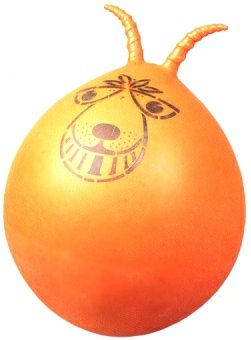
 From Mettoy - Our wonderful orange friend...
May 1968, England, UK - hop into summer with the spacehopper!
We were puzzled by the BBC's dreadfully researched I Love The 1970s series some years back. We were convinced that the space hopper was a craze well before the 1970s began. Well, feast your eyes on the above. The earliest space hopper ads we can find are from April 1968, and in 1968 there was a charity space hopper race in Hyde Park and toy shops and others were organising space hopper races elsewhere. This was MAINSTREAM pop culture, proven by newspapers of the time.

The BBC's I Love series was riddled with errors - the series was reaching into 1981 pop culture in I Love 1979. The Rubik's Cube was not named, remanufactured or sold as such until 1980 - the trademark was registered in the UK on 7 May, 1980. The tiny seepage of Magic Cubes (the first incarnation of the Cube) beyond Hungarian borders was nowhere near enough to bring about any mainstream craze in the UK. Jonathan King took a Rubik's Cube onto Top of the Pops during the summer of 1980, describing it as the 'latest craze in America', it was certainly NOT a craze in the UK. The vast majority of us had no idea what it was.
The BBC seems to have a real obsession with pouring crazes from other decades into the '70s. We don't know why. In the case of the 1980s, is it political? The big bad Thatcher/Reagan 1980s rewritten as completely void of fond memories? Or are their researchers simply stupid?
ORIGINAL ARTICLE:
 Here is an ad for toys, including the space hopper (or SPACEHOPPER, as it is written in the ad!) from the Cambridge Evening News, England, 1969. Click on the illustration for a closer look...
 Due to a faintly tedious tendency to hype the 1970s, both the BBC's "I Love 1970s" website and the Toy Retailers website state that the hopper arrived in Britain in 1971. However, the advertisement you are looking at is real, dates from 1969, and describes the Hopper as a "trend"...
For doubting Thomases, here is the date of the ad - 14 November, 1969 (as with the 1968 and other 1969 clippings), and I would be happy to provide photocopies of the entire newspapers to anybody who cares to examine the matter further - simply go to my profile for the e-mail address. Note: our later research has revealed, of course, that the space hopper was quite old news in the UK by the time the 1970s even started.
 This British Toy Fair brochure from January 1969 features the space hopper, too (see page illustration on the right).
The Miller's Guide Collecting The 1960s by Madeleine Marsh also lists the space hopper as a late 1960s item.
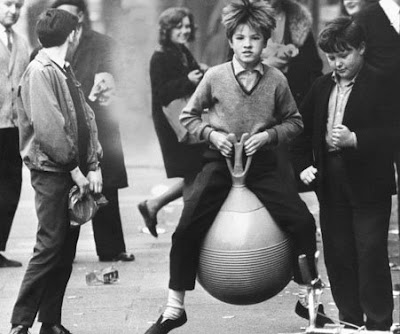 As early as 1967 something called the "bouncing egg", a space hopper-type toy, was at toy fairs in England. The Science and Society galleries contain an excellent picture from April 1967 (featured above), labelled "12 year old Matthew Redmond entertaining people on Stockport Road with his ‘Bouncing Egg’ from the toy fair".
Copyright SSPL/Manchester Daily Express - not to be reproduced without permission.
The space hopper as we know it today, complete with its distinctive face, came into being in 1968 and was on sale in the UK from April that year - and an immediate trend. See illustration below for a round-up of the hopper state-of-play in England and the USA in 1969.
 Hopping mad in 1969... the Space Hopper, complete with its highly distinctive face is in England, UK; the Hoppity Hop and Ride-A-Roo are rampant in the Christmas 1969 Sears and Montgomery Wards mail order catalogues in America.
If you are interested in pop culture, check out your local newspaper archive (I found the 1968 and 1969 space hopper ads in mine). Advertisements for clothes and toys and articles on fads and fashions provide valuable pointers as to what was "hot and what was not" way back then.
Do not, under any circumstances, take the word of the BBC's I Love 1970s, I Love 1980s, or I Love 1990s sites or TV programmes. The BBC's tendency to hype the 1970s ruined the I Love... venture and has infected other sites, like the Toy Retailers. A few years ago, the Toy Retailers site was listing klackers (or klick-klacks) as the "undoubted" toy craze of 1971 - which I'm pretty sure is correct.
In the wake of I Love The 1970s, the Toy Retailers 1971 on-line information was altered to declare the space hopper "Craze Of The Year" - which is completely untrue as the Toy Retailers Association has NEVER made a "Craze of The Year" award and, besides that fact, the space hopper, although still quite popular, was old news by then!
The Hopper was fun, and threw up a lovely echo as I bounced down the path at the side of my gran's house...
Happy days!