Showing posts with label TV. Show all posts

Monday, October 23, 2006

Johnnie and Fanny Cradock...

A 1967 advertisement for Phillips, featuring Fanny and Johnnie.

Rising to fame in shows like Kitchen Magic in the 1950s, TV cooks Fanny and Johnnie Cradock reigned supreme in the 1960s. Fanny was the most formidable woman to ever not don an apron (she didn’t need one) and commented: “I’m no Women’s Libber, I wouldn’t be such a clot!” She didn’t need to be a Women’s Libber. Fanny ate adversaries, male or female, for breakfast!

To watch Fanny and monocled husband Johnnie was to watch a great double act. He played the silly dodderer, she the domineering doyen of the kitchen, and they were compulsive viewing.

Fanny's food was exciting - including such bizarre offerings as blue eggs, and she helped dissolve the mood of post war austerity in the 50s with her lovely (often) French fare. Like many cooks of the time, Fanny believed that French cuisine was it.

But she also dealt with other things. The earliest reference I have yet found to prawn cocktail was in a 1962 episode of Coronation Street, when posh Annie Walker mentioned it. In 1967, Fanny Cradock wrote:

One of the most sordid little offerings is the ubiquitous Prawn Cocktail with a good old ground padding of lettuce cut with a knife and darkening at the edges, a tired prawn drooping disconsolately over the edge of the glass like a debutante at the end of her first ball and its opposite number - a piece of lemon tasting of the knife - clutching the opposite side of the rim like a seasick passenger against a taffrail during a rough Channel crossing. This kind of presentation almost certainly confirms that the mayonnaise will be that bottled stuff, further sharpened by bottled tomato sauce…

Fanny proceeded to give her own super-dupah Prawn Cocktail recipe. Little old me, being lower working class, did not even glimpse a Prawn Cocktail until the 1980s. And then it was the bog standard version - complete with bottled tomato sauce.

And I loved it - wolfed it down. Philistine!

Oh well...

Fanny marched through the 1960s, making numerous television series and writing several books. She entered the 70s as she had entered the 60s - as TV Cook Supreme. But then she came unstuck...

More here.


Thursday, October 19, 2006

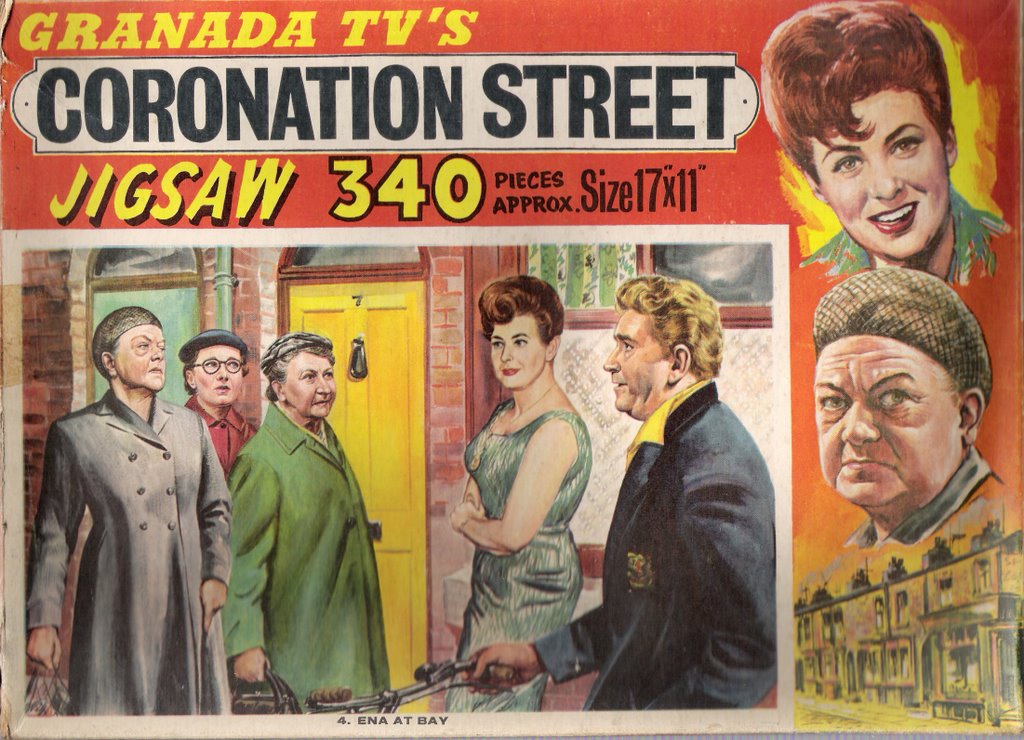
Coronation Street Jigsaw Puzzle - Ena at Bay!

One of a series of jigsaw puzzles from c. 1963 featuring characters from Coronation Street. Note the street featured on the box, which is actually Archie Street, Ordsall - the original template for the Coronation Street architecture. English folklore has been greatly enriched by the addition of television soap opera characters like fearsome old dragon Ena Sharples and the glamorous and fiery Elsie Tanner.

The Street began on 9/12/1960, the creation of one Tony Warren, and continues to entertain a mass audience to this day.

The characters featured in this jigsaw have long departed. Ena Sharples (Violet Carson) left in 1980, and moved to Lytham St Anne's; Martha Longhurst (Lynne Carol) died in the snug of the Rovers Return in 1964; Minnie Caldwell (Margot Bryant) left to keep house for an old friend in 1976; Elsie Tanner (Pat Phoenix) left in 1984 to live in Portugal with an old flame; and Len Fairclough (Peter Adamson) died in a car crash in 1983.

Archie Street was demolished in 1971. More about that
here.

Tuesday, October 17, 2006

Boom Boom Boom Boom - Esso Blue!

This newspaper advertisement dates from November 1960. Joe, the Esso Blue Dealer was a great little creation, introduced in 1958.

I fondly recall the TV ad jingle - "Boom Boom Boom Boom - Esso Blue!" In the first ad, the dealer is seen answering the phone to a number of people wanting to speak to "Joe". The dealer replies that he's not Joe, he's the Esso Blue Dealer. 
At one point, a very sexy-sounding woman phones asking, of course, for Joe. Our dealer pal becomes tongue-tied, replying that he is the "Esso Blee Dooler". Joe himself then phones asking if there have been any calls for him. 

We later learned that the dealer was also called Joe.

According to legend, the "Esso Blee Dooler" line came about because the voice-over actor was late arriving at the recording session for a late 1950s ad at Dorland Advertising Ltd. Dorland executive Tony Solomon stepped forward, eager to get the sound balance right, and said: "Let me have a go at it." He then said "I'm your Esso Blee Dooler" instead of "Esso Blue Dealer", which caused great amusement amongst the staff looking on, and the "blooper" (as the Americans would have it) was scripted into the ad. 

The ad's jingle is etched on my mind. I first heard it as a tiny, tiny tot in the mid-to-late 1960s and the ads went on until some point in the 1970s (post-1973, but I don't have an exact year), when the Esso Blue Dealer sadly took his leave.

I wonder what he's doing now? 

I wonder if he still gets tongue-tied? 

I wonder if I should see a doctor?


A late 1960s Esso Blue badge.

Saturday, September 02, 2006

1960: Sykes And A...

Where did you get that hat?

BBC television comedy series Sykes began on 29 January 1960. The full title of each episode was Sykes and a... - fill in the missing word to reveal the cause of that week's comic misadventure. Causes included a telephone (in the first episode), a dream, a fog and even a Cold War!

Eric Sykes and Hattie Jacques played twins, sharing a house in Sebastopol Terrace, a not-very-posh road somewhere in East Acton.

Next door was Charles Fulbright Brown (Richard Wattis), a prissy and stuck-up thorn in the pair's side, who contributed greatly to the comedy.

Corky Turnbull, the local policeman, played by Deryck Guyler, was on hand - often to add to the chaos of their lives.

The characters were all losers: Eric would often (over) rate his intellect and try to outdo Mr Brown socially at times, but he never succeeded. Hattie was warm and loving and probably the most sensible character in the show, but in Sebastopol Terrace that wasn't saying much. Mr Brown (one of the Shropshire Browns) was stuck up, waspish and enjoyed preening, but there was something a little sad and vulnerable about him, and one got the feeling he was faking the high regard in which he said he was held by local society. And Corky was not a very good policeman at all, given to being unintelligent, pompous and officious and thinking of his stomach far too often.

But each character was very lovable.

The first series of Sykes scripts were written by Johnny Speight (of Alf Garnett fame), and then Eric took over - with a few contributions from Spike Milligan and John Antrobus, and Johnny Speight providing a few of the ideas.

Sykes was a hugely popular series which finally came to an end in November 1965. Or so it was thought at the time, for the show was revived in 1972 and was again a success, running until 1979.

Hattie's death in 1980 put paid to hopes for further episodes.

Sykes is fondly remembered to this day.

More on the 1970s revival of Sykes here.

Friday, September 01, 2006

Mr Mix From Nesquik

Mr Mix - the man from Nesquik!

I had (and in fact still have) a Mr Mix (a cartoon character who advertised Nesquik) glove puppet. The head was made of plastic and I always thought my finger smelled fascinating when it had been in there...

Strange days indeed...

Mr Mix wasn't the most exciting cartoon character ever to appear in TV advertising. In fact, he lacked character, and simply twirled about acrobatically, looking jolly and stirring various milk shakes. Despite this, I loved him dearly and nothing could part me from my Mr Mix puppet!

Happy days with...

Mr Mix - the glove puppet...

Mr Mix is so chuffed about Nesquik...

Two Mr Mix tumblers - a special offer from Nesquik back in the 1960s.

Advertisement from a children's comic, 1969 - "URGENT! Help Mr. Mix spot the silhouettes."

The Mr Mix "Bendy" toy.


Saturday, August 19, 2006

1969: Dr Who Exiled to Planet Earth


As every Dr Who fan knows, Patrick Troughton relinquished the title role in 1969.

In the story, the Tardis was grounded and the Doctor exiled to earth by the Time Lords. The Doctor also had a change of face and actor as Jon Pertwee took on the role for the 1970 series, portraying him as a cross between a retro dandy and a dashing James Bond figure, armed with brilliant gadgetry - such as the famous sonic screwdriver.


The Dr Who picture strip featured here, which apeared in TV Comic on 5/7/1969, adheres to the Doctor-exiled-to-earth storyline, but still features the image of Patrick Troughton as the Doctor, although in the series I believe that the Doctor was already in the guise of Jon Pertwee when he reached earth.

According to one very helpful source, TV Comic adhered to the series continuity: the Doctor was dragged into the Tardis to have his appearance changed by the Time Lords as Jon Pertwee took up the role at the start of the 1970 series on television.