Sunday, July 29, 2007

Compact

The co-devisors of "Compact" - Hazel Adair...

... and Peter Ling - both far better known for the ATV soap opera "Crossroads", which debuted in November 1964. "Compact" told the story of a bunch of highly talented people, plus a gossipy secretary and her rather common boyfriend, who staffed a women's magazine. The show began on BBC 1 on 2 January 1962.

All at sea - the cast of "Compact" - including Carmen Silvera, later of "'Allo 'Allo" fame, who played cheroot smoking Camilla Hope, and, to the left, Sonia Fox, "Compact" secretary Susan Caley, later Sheila Harvey in "Crossroads". Another "Compact" actress who went on to greater fame elsewhere was Rachel Gurney, Celia Randall in "Compact", Lady Marjorie Bellamy in "Upstairs, Downstairs".

Good natured Anthea only took a job at "Compact", to establish her independence from her wealthy family. Here we see her being nice to shy Alan - played by Basil Moss, later Peter Tyson of BBC Radio 2's soap "Waggoners' Walk" (1969-1980). Of course, there were complications as Alan believed that Anthea was in love with him, as he was with her.

Oh dear.

Big noise Edmund Bruce rips up a copy of "Compact" as editor Mark Viccars looks on in absolute horror. Is this the end of the road for the magazine?

A "Compact" annual.

Another "Crossroads" link - Ronald Allen, right, was Ian Harmon in "Compact" and David Hunter at the motel. The woman in the cover picture is actress Monica Evans, Sally Henderson in the show. Secretary Sally found herself swept off her feet by suave boss man Ian. Marriage followed.

Wednesday, November 29, 2006

Passe Partout Framing - Coming To A Sticky End...

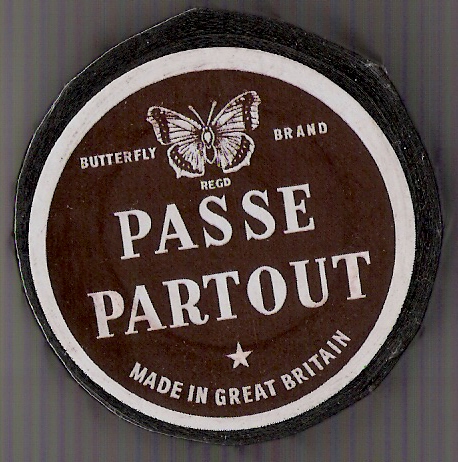
A reel of Samuel Jones Butterfly Brand passe partout tape. Passe partout was becoming passé in the 1960s.

Samuel Jones, a company that had a factory in St Neots, Cambridgeshire, not far from my home town, made passe partout. It was a paper tape - used to frame pictures. The tape could be bought in reels and, once water was applied to the gummed side, would stick to a range of surfaces FOREVER!

Lordy, was it sticky!

For passe partout tape framing, one would select a picture, buy glass cut to measure, make a backing card for the picture, insert passe partout hanging rings into the reverse of the backing card, mount the picture on the front, place the glass over it and tape the whole lot together. There really was an art to passe partout - it could be terribly messy.

But, carefully done, passe partout frames could look pretty darned special. The tape came in a range of attractive finishes.

Passe partout was popular for many, many years, but was in decline by the 1960s. The reels pictured above date from around then. My gran used to get us children doing passe partout pictures on rainy days when we visited her in the 70s, and I last bought a reel of passe partout to frame a picture for my bedsit in 1986.

By then, with a wide range of cheap ready-made picture frames available, passe partout tape framing was really on its last legs. I'm told that the last reels were sold in the early 1990s.

A brand of tape is sold today which is sometimes referred to as "passe partout", but it is cloth, not paper, and bears no resemblance to the tape described here.

Above and below - front and back views of a passe partout picture framing kit box from the 1950s or '60s.


Sunday, November 05, 2006

The Groovy 60s - Abbey National becomes Fabby National, and a Cure for the Hippy Look...

How can you be "with it" without money? Good question! The "non-materialistic", peace and love hippie lifestyle seemed to require lots of bunce - you couldn't "drop out" without it!

Very good play on the word "hippie", and one of my favourite magazine ads - it dates from 1968. Did any readers ever try Limmits chocolate wafers way back then and, if so, did they help your calorie controlled diet?

If you've a Limmits tale to tell us, please go to "My Profile" for the e-mail address.

Cassettes - Join The Tape Revolution!

Before there were only vinyl records or spool-to-spool tapes, but now we had cassettes! A British magazine advertisement from 1968.

Saturday, November 04, 2006

It's All At The Co-op Now!

Crumbs! What a nosh-up!

The famous Co-op slogan and jingle originated in the 1960s (these ads are from 1968) and continued into the 1970s. Around the mid-70s, the slogan was changed to "Your Caring Sharing Co-op" and a new jingle arrived which wasn't half as much fun!

"It's All At The Co-op Now!", which was sometimes tweaked to "It's All At Your Co-op Now!", are both etched on my brain.

My head is simply full of old advertising jingles from the 1960s, 70s and 80s!

Decimalisation Looms - The New Coins Arrive...

December 1968...

Britain is being "converted". In a shake-up that will alter the language and affect the thinking of 55 million people, the country is deserting long familiar feet, pounds, rods, quarts and bushels - and going metric.

The change-over, which received official government support in May 1965, will take ten years to complete. The first major step to pave the way for later ordeals, is the switch to decimal currency, using a pound composed of 100 pence. New coins have been circulating since April [1968], heralding the approach of Decimal Day: February 15, 1971.

The Reader's Digest article makes for fascinating reading. I was surprised to learn that the now familiar new coins were designed in the 60s - I had formerly believed that only the fifty pence piece was.

The new coins are pictured in the two pages of the 1968 article featured above, with the exception of the ten new pence, which was pictured on an adjacent page, and the fifty new pence, which replaced the old Bank of England ten shillings note in 1969.

Here we see a July 1969 call from the Decimal Currency Board to shops and small businesses to ensure that the change-over of their cash registers and price-computing scales is on course.

Scotch With That Ten Foot Feeling...

Here's Melvyn Hayes starring in a magazine advertisement for Scotch whisky. 1968.

Mateus Rosé

A 1968 magazine ad for Mateus Rosé - essential for that 1960s party vibe!

Thursday, November 02, 2006

The Perishers: "A Million Housewives Every Day, Pick Up A Tin Of Beans And Say..."

The very first "Perishers" book - 1963. Below: Maisie faces the harsh realities of life in 1967.

According to the excellent Authentic Perishers site (link at end of this post), The Perishers newspaper comic strip began life in the Manchester edition of the Daily Mirror in February 1958 and was the idea of the cartoon editor, Bill Herbert. It was scripted by Ben Witham and drawn by Dennis Collins.

With the strip ailing, advertising artist/writer Maurice Dodd was brought in, replacing Ben Witham. The strip then thrived and, in October 1959, appeared in the national editions of the Daily Mirror.

Dennis Collins retired in 1983 and Maurice Dodd then produced The Perishers alone until 1992 when he went into partnership with illustrator Bill Mevin.

So, what was it all about?

The action revolved around a group of kids - go-cart building orphan Wellington; pushy May Queen wannabe Maisie; Maisie's nightmare of a brother, Baby Grumplin'; and moronic Marlon, the love of Maisie's life.

Wellington's dog, Boot, who believed that he was actually an 18th Century English nobleman, was also a major mover and shaker on The Perishers scene. Recurring characters included an Aldolf Hitler clone tortoise called Kilroy and a group of crabs in a rock pool, exalting over the annual appearance of "The Eyeballs In The Sky".

And then there was Tatty Oldbitt, the sailors' friend, and potty newshound BH (Calcutta) Failed. And what about Beryl Bogey (Urk! Urk! Urk!), Dirty McSquirty and those oddball insects?

The Perishers were quirky and fabulous.

I say "were" because, finally, in 2006, those "perishing kids" made their last appearance. I confess to shedding a few tears, 'cos I loved them very much. I always read the gang's latest exploits whilst I was having my breakfast and was rarely left un-amused. There were times when I'd still be having attacks of Perishers-induced giggles on the bus on the way to work - and it takes a lot to make me laugh before midday.

Two of the central purveyors of The Perishers - Maurice Dodd, who wrote the strip for almost fifty years, and Dennis Collins, who illustrated it for around 25 years, are no longer with us. Mr Dodd died in 2005 and Mr Collins in 1990.

In the strip above, which first appeared in 1967, Maisie, my favourite character, is discovering that real life isn't like the telly commercials!

Remember:

A Million Housewives Every day

Pick Up a Tin of Beans and Say

Beanz Meanz Heinz!
--------------------------

The Authentic Perishers, THE site for The Perishers, is here.

Wednesday, November 01, 2006

Barclaycard - "The New Kind of Money"...

Finding this advertisement for Barclaycard in a 1967 Readers Digest rather surprised me as the concept of "plastic money" had no real effect on me or my family until the mid-1980s.

It is worth taking a copy of the ad and enlarging it so that you can read the inset letter which contains such gems as:

Alright, you've been swamping me, for almost a year, with this fancy propaganda about how you 'make shopping simpler'.

So it would seem that the card had been around for almost a year by April 1967.

WOW!

I was born in 1965, so don't remember 1967, but as a working class kid in the 1970s, I knew nobody who had a credit or debit card. In fact, round where I lived, not many people had bank accounts!

Every week, my step father would bring home his pay packet (he was paid in cash), put it on the kitchen table, and he and my mother would work out the finances for the week.

We knew about credit cards, they were advertised, but as a kid I never thought that I would have one. There was "Them" (those that did have them) and "Us" (those that did not have them) and the gulf seemed unbridgeable.

When I began work in the early 1980s, I, like my step father, was paid in cash and the whole of the office where I worked looked forward to Thursday when the pay packets were brought round.

Some years later, I changed employers and my new boss paid salaries directly into bank accounts. It was then that I opened an account and first met plastic money via a debit card.

I was considered very advanced and adventurous by most of my family.

And this was in the 1980s.

The 1960s were certainly ahead of their times on occasion!

1967: "Peace and Love? But Won't that Ruin the Carpet, Dear?"

The girl with the winklepickers and the panda eyes wants a groovy party. Mum wants to preserve her lounge carpet. How can both their interests be catered for?

Monday, October 30, 2006

Lost In Space with Dr Smith and a Bubble Headed Booby...

Lost In Space was Dr Zachary Smith (Jonathan Harris). The show began in the States in 1965 and was later shown in England.

Whether clashing with that "bubble headed booby" of a robot, or calming the space family Robinson with those tremendously comforting words, "Never fear, Smith is here!" the good doctor, who began as rather a sinister presence, soon became a classic comic character - fondly remembered to this day.

Miss Nugent gets an Eyeful!

The late Reg Smythe's famous creation Andy Capp made his debut in 1957 and is seen here in 1963, having his weekly dip in the tub in front of the telly. But who is "Miss Nugent"? You might know her better as Emily Bishop, wife of the late Ernest and long-time Coronation Street regular.

Miss Nugent was a shy spinister in the early 1960s - hence Florrie's concern!

Friday, October 27, 2006

A Hippie Toaster...

This Morphy Richards toaster is decorated with influential designer Mary Quant's daisy motif.

Groovy, as the hippies might have said.

Twentieth Century Words by John Ayto (Oxford, 1999), informs us that the term hippie/hippy emerged in the early 1950s - "originally a low-profile synonym of hipster (1941) - i.e. someone who is 'hip' or in touch with fashionable tastes - hippie suddenly made it into the big time in the mid 1960s".

The hippies, of course, preached Peace and Love.

Many hippies took mind expanding drugs.

Hippies were usually middle class at the very least - the working classes could not afford to "drop out".

Most hippies protested against war.

Most hippies wore weird clothes.

Many hippies liked to go to rock concerts in muddy fields.

Many hippies wore ethnic clothes.

Hippies were often into religion - but usually not Church of England or anything else their parents were into.

Some hippies liked to be hairy.

Most hippies loved bell bottoms and flared trousers.

Many hippies were very promiscuous.

Just about every hippie believed in the freedom of the individual.

Many hippies were incredibly earnest.

Nowadays some members of the hippie generation decry every generation that has followed, giving them labels such as "Generation X" and accusing them of being boring, conservative copyists. Many seem to believe that their generation invented youthful idealism.

Maybe the hippie generation could do with a refresher course in Peace and Love?

In the meantime, how about a nice slice of toast from a Mary Quant toaster to be going on with? Wholemeal, of course...

Women's Lib...

Gender issues were high on the agenda in the 1960s. Or perhaps that should be "Women's Issues" as the general perception of the time was that women were very much the underdogs and men had always been able to do exactly what they wanted (actually, as a kid and a teenager, I fought a battle royal with my mother who tried to force me into conforming to what I regarded as stereotypical "male" behaviour, but that's another story!).

The 60s saw the emergence of the Women's Liberation Movement, or Women's Lib, and (above) we see signs of its growing success in a newspaper ad from 1969.

1969 again: as traditionally male careers were opening up to women, so the new freedom began to spread to men, see the ad above - "More and more men are joining the nursing profession".

In the 1980s, there briefly emerged a new species - the "
Eighties Man" or "New Man". But this was later overshadowed by the emergence of the 1990s New Lad.

Monday, October 23, 2006

Johnnie and Fanny Cradock...

A 1967 advertisement for Phillips, featuring Fanny and Johnnie.

Rising to fame in shows like Kitchen Magic in the 1950s, TV cooks Fanny and Johnnie Cradock reigned supreme in the 1960s. Fanny was the most formidable woman to ever not don an apron (she didn’t need one) and commented: “I’m no Women’s Libber, I wouldn’t be such a clot!” She didn’t need to be a Women’s Libber. Fanny ate adversaries, male or female, for breakfast!

To watch Fanny and monocled husband Johnnie was to watch a great double act. He played the silly dodderer, she the domineering doyen of the kitchen, and they were compulsive viewing.

Fanny's food was exciting - including such bizarre offerings as blue eggs, and she helped dissolve the mood of post war austerity in the 50s with her lovely (often) French fare. Like many cooks of the time, Fanny believed that French cuisine was it.

But she also dealt with other things. The earliest reference I have yet found to prawn cocktail was in a 1962 episode of Coronation Street, when posh Annie Walker mentioned it. In 1967, Fanny Cradock wrote:

One of the most sordid little offerings is the ubiquitous Prawn Cocktail with a good old ground padding of lettuce cut with a knife and darkening at the edges, a tired prawn drooping disconsolately over the edge of the glass like a debutante at the end of her first ball and its opposite number - a piece of lemon tasting of the knife - clutching the opposite side of the rim like a seasick passenger against a taffrail during a rough Channel crossing. This kind of presentation almost certainly confirms that the mayonnaise will be that bottled stuff, further sharpened by bottled tomato sauce…

Fanny proceeded to give her own super-dupah Prawn Cocktail recipe. Little old me, being lower working class, did not even glimpse a Prawn Cocktail until the 1980s. And then it was the bog standard version - complete with bottled tomato sauce.

And I loved it - wolfed it down. Philistine!

Oh well...

Fanny marched through the 1960s, making numerous television series and writing several books. She entered the 70s as she had entered the 60s - as TV Cook Supreme. But then she came unstuck...

More here.


Sunday, October 22, 2006

A Brief History of the Lava Lamp...

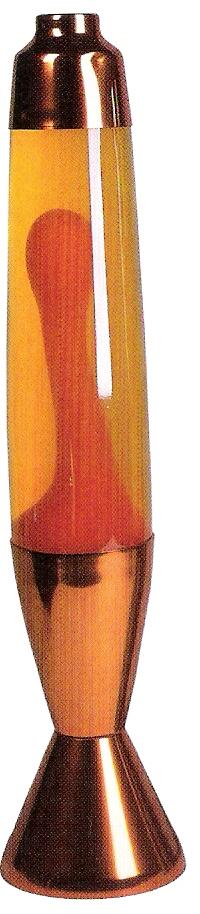
The history of the lava lamp began in a pub in Hampshire, England, with a very unusual egg timer.

In the 1940s, one Edward Craven-Walker walked into the aforementioned pub and saw a strikingly odd object on the counter behind the bar. It was a glass cocktail shaker containing some kind of mucus-like blob floating in liquid. Mr Craven-Walker made enquiries, and was told by the barman that the device was an egg timer. The 'blob' was actually a clump of solid wax in clear liquid.

How did this “time” your egg, wondered Mr Craven-Walker? The barman elaborated:

“You put the shaker in the boiling water with your egg, and as the boiling water cooks the egg it also melts the wax turning it into an amorphous blob of goo.”

When the wax floated to the top of the jar, the egg was done. Mr Craven-Walker was very impressed by what he saw and he began to wonder - could he turn the egg timer into a lamp with thicker oil that would form sculptural shapes? Would this be a viable commercial product?

The inventor of the blobby egg timer, somebody called Dunnet, was deceased, so Craven-Walker was able to patent the invention for himself. The Astro/Lava Lamp was finally released in 1963. Craven-Walker had spent fifteen years perfecting the design.

In the hippy-trippy Summer of Love in 1967, the lamp gained great popularity - mainly with trendies and people experimenting with mind-expanding drugs.

In the early 1970s, the lamp became deeply naff. It was seen on the serving hatch at Stan and Hilda Ogden’s in Coronation Street - a sure sign of its complete and utter non-trendiness, and then Mildred Roper acquired one in George & Mildred.

Oh dear! My mother, middle aged and with absolutely lousy taste, bought one and we spent the evenings trying to avoid looking at something that resembled a blob of orange liver in yellow bile floating up and down.

At our local pub, which was all plastic beaten copper tables and “genuine” olde Englishe horse brasses, a lava lamp suddenly appeared. Frumpy Nellie and Fred, the mine hosts, were thrilled with the thing and became a bit of a laughing stock amongst right-minded regulars.

Finally, the lava lamp’s fascination for (a minority of) 30 and 40-somethings evaporated, and by 1980 they were just about dead and gone.

C. 1988, the awful blobby shapes associated with lava lamps appeared in a couple of pop videos. The new drug culture of the Acid House/Rave era seemed happy to embrace a couple of icons from the original Summer of Love. The lava lamp was one, the Smiley Face was another. Not that 1988 seemed like a second Summer of Love to me. It was faster and more streetwise - “Right on one, matey!” but, as we moved into the 1990s, 1960s trends became more and more “in” and lava lamp sales boomed.

Apparently more lava lamps were sold in the 1990s than in the 1960s, 1970s and 1980s combined.

Bleurgh!!

Thursday, October 19, 2006

Coronation Street Jigsaw Puzzle - Ena at Bay!

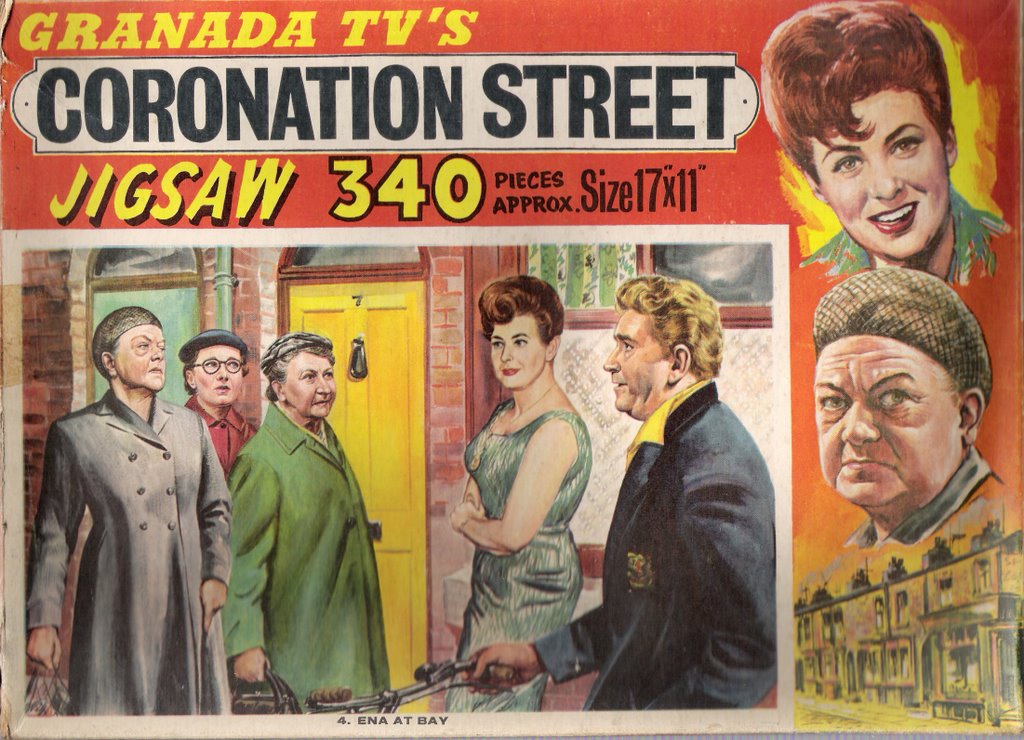
One of a series of jigsaw puzzles from c. 1963 featuring characters from Coronation Street. Note the street featured on the box, which is actually Archie Street, Ordsall - the original template for the Coronation Street architecture. English folklore has been greatly enriched by the addition of television soap opera characters like fearsome old dragon Ena Sharples and the glamorous and fiery Elsie Tanner.

The Street began on 9/12/1960, the creation of one Tony Warren, and continues to entertain a mass audience to this day.

The characters featured in this jigsaw have long departed. Ena Sharples (Violet Carson) left in 1980, and moved to Lytham St Anne's; Martha Longhurst (Lynne Carol) died in the snug of the Rovers Return in 1964; Minnie Caldwell (Margot Bryant) left to keep house for an old friend in 1976; Elsie Tanner (Pat Phoenix) left in 1984 to live in Portugal with an old flame; and Len Fairclough (Peter Adamson) died in a car crash in 1983.

Archie Street was demolished in 1971. More about that
here.

Tuesday, October 17, 2006

Boom Boom Boom Boom - Esso Blue!

This newspaper advertisement dates from November 1960. Joe, the Esso Blue Dealer was a great little creation, introduced in 1958.

I fondly recall the TV ad jingle - "Boom Boom Boom Boom - Esso Blue!" In the first ad, the dealer is seen answering the phone to a number of people wanting to speak to "Joe". The dealer replies that he's not Joe, he's the Esso Blue Dealer. 
At one point, a very sexy-sounding woman phones asking, of course, for Joe. Our dealer pal becomes tongue-tied, replying that he is the "Esso Blee Dooler". Joe himself then phones asking if there have been any calls for him. 

We later learned that the dealer was also called Joe.

According to legend, the "Esso Blee Dooler" line came about because the voice-over actor was late arriving at the recording session for a late 1950s ad at Dorland Advertising Ltd. Dorland executive Tony Solomon stepped forward, eager to get the sound balance right, and said: "Let me have a go at it." He then said "I'm your Esso Blee Dooler" instead of "Esso Blue Dealer", which caused great amusement amongst the staff looking on, and the "blooper" (as the Americans would have it) was scripted into the ad. 

The ad's jingle is etched on my mind. I first heard it as a tiny, tiny tot in the mid-to-late 1960s and the ads went on until some point in the 1970s (post-1973, but I don't have an exact year), when the Esso Blue Dealer sadly took his leave.

I wonder what he's doing now? 

I wonder if he still gets tongue-tied? 

I wonder if I should see a doctor?


A late 1960s Esso Blue badge.

Sunday, October 15, 2006

Yeast-Vite Pick-Me-Up...

Here's a 1960s packet of Yeast-Vite.

These little pick-me-up pills were highly popular right from the time of their debut around the 1920s. My grandmother swore by them, and was never without a packet in her handbag.

Yeast-Vite is still available today.

Friday, October 13, 2006

1969: David Bowie and The Stylophone...


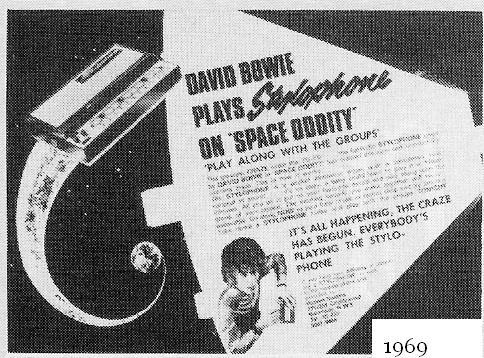
The Dubreq Stylophone, a miniature electronic musical instrument, invented in 1967 by one Brian Jarvis, consisted of a metal keyboard that was played by touching it with a stylus.

David Bowie used a Stylophone on his 1969 hit Space Oddity and Rolf Harris advertised them.

How exciting! A great deal of fuss has been made of the Stylophone on 1970s nostalgia shows and websites (70s? It was actually first available in the 60s!) but that, in my opinion, simply shows desperation to glitz the 70s up.

The only person I ever knew that owned a stylophone was my dear old gran, who had just got rid of her piano to make more space.


Sadly, she found the Stylophone no substitute.

---------------------

Saturday, September 02, 2006

1960: Sykes And A...

Where did you get that hat?

BBC television comedy series Sykes began on 29 January 1960. The full title of each episode was Sykes and a... - fill in the missing word to reveal the cause of that week's comic misadventure. Causes included a telephone (in the first episode), a dream, a fog and even a Cold War!

Eric Sykes and Hattie Jacques played twins, sharing a house in Sebastopol Terrace, a not-very-posh road somewhere in East Acton.

Next door was Charles Fulbright Brown (Richard Wattis), a prissy and stuck-up thorn in the pair's side, who contributed greatly to the comedy.

Corky Turnbull, the local policeman, played by Deryck Guyler, was on hand - often to add to the chaos of their lives.

The characters were all losers: Eric would often (over) rate his intellect and try to outdo Mr Brown socially at times, but he never succeeded. Hattie was warm and loving and probably the most sensible character in the show, but in Sebastopol Terrace that wasn't saying much. Mr Brown (one of the Shropshire Browns) was stuck up, waspish and enjoyed preening, but there was something a little sad and vulnerable about him, and one got the feeling he was faking the high regard in which he said he was held by local society. And Corky was not a very good policeman at all, given to being unintelligent, pompous and officious and thinking of his stomach far too often.

But each character was very lovable.

The first series of Sykes scripts were written by Johnny Speight (of Alf Garnett fame), and then Eric took over - with a few contributions from Spike Milligan and John Antrobus, and Johnny Speight providing a few of the ideas.

Sykes was a hugely popular series which finally came to an end in November 1965. Or so it was thought at the time, for the show was revived in 1972 and was again a success, running until 1979.

Hattie's death in 1980 put paid to hopes for further episodes.

Sykes is fondly remembered to this day.

More on the 1970s revival of Sykes here.

Friday, September 01, 2006

Mr Mix From Nesquik

Mr Mix - the man from Nesquik!

I had (and in fact still have) a Mr Mix (a cartoon character who advertised Nesquik) glove puppet. The head was made of plastic and I always thought my finger smelled fascinating when it had been in there...

Strange days indeed...

Mr Mix wasn't the most exciting cartoon character ever to appear in TV advertising. In fact, he lacked character, and simply twirled about acrobatically, looking jolly and stirring various milk shakes. Despite this, I loved him dearly and nothing could part me from my Mr Mix puppet!

Happy days with...

Mr Mix - the glove puppet...

Mr Mix is so chuffed about Nesquik...

Two Mr Mix tumblers - a special offer from Nesquik back in the 1960s.

Advertisement from a children's comic, 1969 - "URGENT! Help Mr. Mix spot the silhouettes."

The Mr Mix "Bendy" toy.


Saturday, August 19, 2006

1969: Dr Who Exiled to Planet Earth


As every Dr Who fan knows, Patrick Troughton relinquished the title role in 1969.

In the story, the Tardis was grounded and the Doctor exiled to earth by the Time Lords. The Doctor also had a change of face and actor as Jon Pertwee took on the role for the 1970 series, portraying him as a cross between a retro dandy and a dashing James Bond figure, armed with brilliant gadgetry - such as the famous sonic screwdriver.


The Dr Who picture strip featured here, which apeared in TV Comic on 5/7/1969, adheres to the Doctor-exiled-to-earth storyline, but still features the image of Patrick Troughton as the Doctor, although in the series I believe that the Doctor was already in the guise of Jon Pertwee when he reached earth.

According to one very helpful source, TV Comic adhered to the series continuity: the Doctor was dragged into the Tardis to have his appearance changed by the Time Lords as Jon Pertwee took up the role at the start of the 1970 series on television.

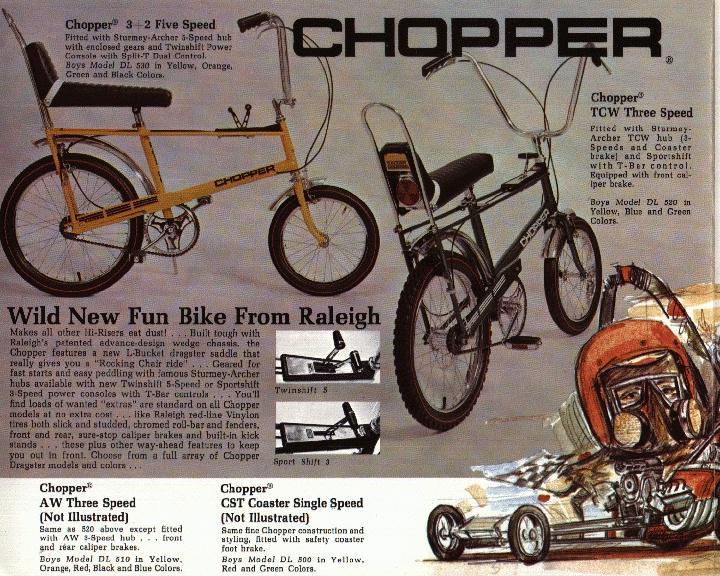
1969: The Raleigh Chopper Bike Arrives in Britain...


"English High-Rise Bikes..."
Two 1969 advertisements for the Raleigh Chopper bike...

The famous Raleigh Chopper bike went on sale in America in 1968 and in Britain in September 1969.

The bike was invented by one Alan Oakley and enjoyed a long period of popularity here.

Wednesday, April 19, 2006

1960s Hippie Era Fashions - Flares, Afghan Coats, Minis and Maxis...

A glimpse of the fashions of 1969...

One of the best ways to research fashion trends is by looking through your local newspaper archives. Some libraries have "local studies" sections, with local newspapers on microfilm. If you look at, in this case, 1969, you will know that flares and space hoppers were on sale in everyday shops - despite the BBC telling you on their "I Love 1970s" website and programmes that both didn't arrive until the 1970s!!

The BBC tells us that flares were 70s, bell bottoms were 60s, which is ridiculous. The 1969 advertisements featured here reveal the lie and flares and bell bottoms were actually popularised by the mid-to-late-60s hippie movement.

The BBC has a bizarre 1970s fixation, and is not to be trusted when it comes to pop culture history relating to that decade.

In the 70s, we struck a recession and fashion got rather stuck. On many housing estates across the land, flares were part of a grim teen uniform - and you had to wear them. Where I lived, to differ from the norm was to risk a bloody nose - or worse.

"Big trousers" had been around before, like most fashions, but in the mid-to-late 60s, flares and bell bottoms were considered new and very groovy!


Note the Americanism - flared pants - not trousers. Very groovy.

Cor - wot whoppers, missis!!

More 1969 newspaper advertisements.

Remember maxi macks? ("mack" = short for mackintosh, a type of coat). And what about Afghan coats? Didn't some of them pong? A really yucky, high sweet smell. One of my mum's friends had one that made me want to throw up whenever she cuddled me (I was about four at the time!!).

And wouldn't you just know it - she was the cuddly type, never happier than when enveloping some poor innocent kid in Afghan coat odour...
*********************************
Look at those flares! The maxi had arrived, but the mini was still far more popular!